

The “Walking Toupee” in Your Oak Tree
CLERMONT, Fla. – On a humid Central Florida afternoon, you’re doing something completely normal, like checking the mailbox, walking the dog, or pretending you’re “just going to pull one weed real quick.” Then you spot it on a trunk or low branch: a little furry blob, tapered like a tiny comet, just sitting there.
Your brain immediately offers a terrible idea: That looks soft.
This is the moment where we, as a species, must show growth.
Because that fuzzy lump might be the southern flannel moth caterpillar (Megalopyge opercularis), better known as the puss caterpillar, and underneath that silky coat are venomous spines that can deliver a seriously painful sting.
What is it, exactly? Caterpillar vs. moth
First, the name confusion cleanup:
- The puss caterpillar is the larval stage of Megalopyge opercularis. This stage has hollow spines connected to venom glands, hidden under soft-looking hairs.
- The adult is the southern flannel moth, a small, fuzzy moth with yellowish wings and an orange-tinted “flannel” body. The adult moth is not what people are usually talking about when they warn you about stings—the caterpillar is the main hazard.
How to identify a puss caterpillar
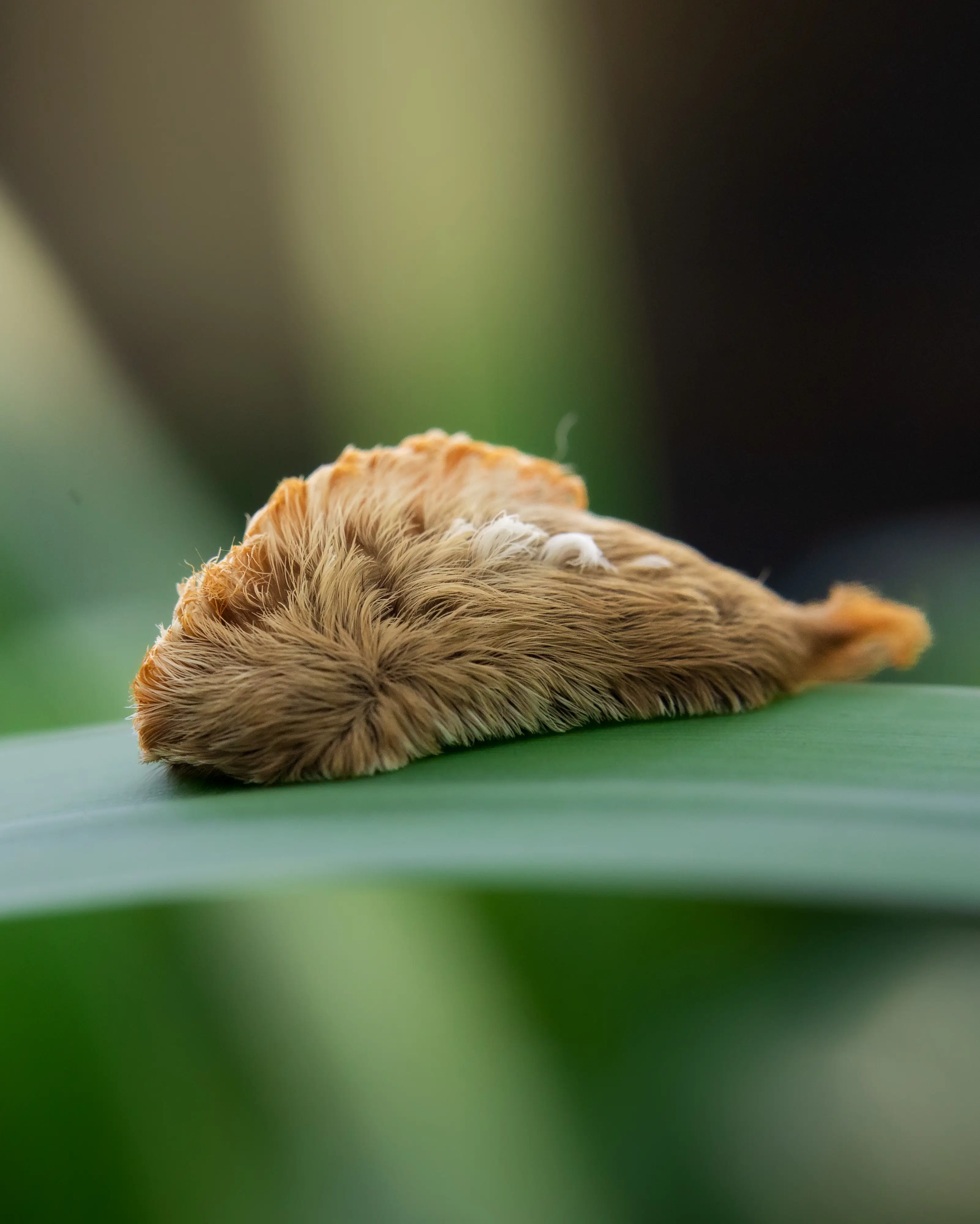
Puss caterpillars are often described as teardrop-shaped, with long, silky hairs that can look gray, tan, cream, or reddish-brown. Many have a tail-like extension at the rear. Their head is often hidden beneath all that fluff, which adds to the illusion that this is a harmless little pom-pom that fell out of a craft store.
Key detail: the dangerous spines are underneath the soft hairs, so you can’t “check” if it’s safe by poking it. Also don’t poke it. That’s the whole point.
Habitat and range: why Central Florida sees them
According to UF/IFAS, Megalopyge opercularis occurs from New Jersey to Florida and west to Arkansas and Texas, and it’s common in Florida. You’re most likely to encounter them in the places we all share with shade trees: yards, parks, school grounds, and neighborhood streets, especially around host plants.
They feed on a wide variety of plants, but in Florida they’re commonly found on oaks and elms. UF/IFAS also notes that they’re often found on citrus.

Exclusive membership newsletter for News 6 Insiders.
Life cycle: the short version
UF/IFAS describes the southern flannel moth as bivoltine, meaning it typically has two broods per year, with a possible partial third brood farther south. In Florida, UF/IFAS summarizes it as two generations: one in spring and one in fall.
The general flow:
- Adult moths emerge, mate, and females lay eggs on foliage or small twigs.
- Eggs hatch in about six to eight days.
- Larvae feed and grow, becoming progressively hairier with each molt.
- Mature larvae spin tough cocoons that can remain on trees long after the moth has emerged.
- The adult moth emerges through an “operculum”—a little door-like structure on the cocoon.
Why people mistake it for something harmless
Because it’s basically designed to be misunderstood.
The puss caterpillar looks like:
- a tuft of fur
- a tiny wandering wig
- a cottony seed clump that gained mobility
- something that should obviously be on a kids’ cartoon sticker sheet
UF/IFAS and other extension resources point out the catch: those soft-looking hairs conceal rows of hollow spines with venom glands. The fuzzy appearance is not an invitation—it’s a warning label written in cursive.
The real warning: the sting is no joke
Multiple authoritative medical and extension references describe puss caterpillar stings as notably painful.
Merck Manual states that when the caterpillar is pressed against skin, venomous hairs become embedded, and envenomation can cause intense pain, burning, and a rash. More susceptible individuals may experience broader symptoms, and severe reactions are treated like other serious insect stings.
Most encounters are localized and manageable, but some people can have stronger reactions. Take contact seriously, especially with children.
What to do if you touch one
If remove embedded spines or hairs and treat symptoms a more serious reaction.
Poison Control recommends:
- Remove the caterpillar without using your hands if it is still on the skin. Use a stick or another tool.
- Use tape: place tape sticky-side down on the area and pull it up to remove hairs or spines. Repeat with fresh tape as needed.
- Wash gently with soap and water.
- For itch relief, Poison Control lists options including baking soda paste and hydrocortisone cream.
- If blistering is severe or symptoms are concerning, contact a healthcare provider.
Merck Manual also includes washing with soap and water, local cooling measures such as an ice pack, and using tape to remove embedded hairs.
For personalized guidance, contact Poison Control at 1-800-222-1222 in the United States. The service is free and available 24/7.
Seek urgent medical care immediately if there is trouble breathing, facial swelling, widespread hives, severe or escalating symptoms, or if the sting involves the eyes or mouth.
Safety guidance for children and pets
For kids
- Teach the simple rule: “If it’s fuzzy, it’s not your friend.”
- Supervise children around trees and outdoor play areas during seasons when caterpillars are active.
- If you find one on a play structure or frequently touched spot, don’t smash it with bare hands. Use tools and appropriate protection, or contact a pest professional if needed.
For pets
Keep dogs from sniffing or licking caterpillars on sidewalks, tree bases, or low branches. If a pet mouths one, drools, paws at its mouth, or shows sudden distress, call your veterinarian right away.
Ecological role
Puss caterpillars are part of Florida’s food web.
As larvae, they’re plant-feeders that usually don’t cause major tree damage in typical numbers. They’re also prey—and hosts—for natural enemies such as parasitic wasps and flies, which help keep populations in check.
In other words: they’re not “bad.” They’re just extremely committed to personal space.
How to observe them respectfully
If you want to watch or photograph a puss caterpillar:
- Keep a respectful distance.
- Use zoom instead of fingers.
- Don’t move it with bare hands.
- If it’s in a risky location, use extreme caution and appropriate protection—or leave relocation to someone equipped to do it safely.
- Treat cocoons with caution too. UF/IFAS notes that cocoons can persist on trees long after emergence.
Everyday Wild rule of thumb: the best wildlife encounters end with everyone alive, un-stung, and still able to brag about it later.
