

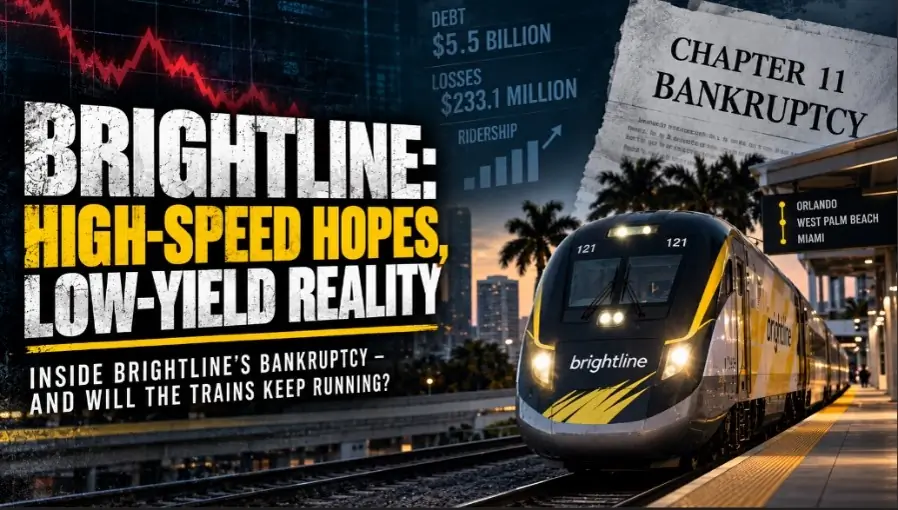
ORLANDO, Fla. – What to Know:
- Brightline has filed for Chapter 11 bankruptcy protection.
- The company is using Chapter 11 to restructure roughly $1.1 billion in corporate debt.
- Though several Brightline parent and affiliated companies have filed for bankruptcy, the LLC that operates the trains has not.
Recommended Videos
In a long-anticipated move, passenger rail operator Brightline formally filed for Chapter 11 bankruptcy protection on Thursday. The petitions hit the U.S. Bankruptcy Court for the District of New Jersey in Newark just before midnight. The case is part of a broader restructuring of Brightline’s multibillion-dollar debt load while keeping its passenger trains running on schedule.
Brightline has also reached a restructuring agreement with a group of its financial stakeholders.
For passengers from Miami to West Palm Beach to Orlando, service remains business as usual.
There’s More Than Just One Brightline
Here’s where Brightline’s bankruptcy gets complicated: the company passengers know simply as “Brightline” is actually made up of a web of separate corporate entities.
Seventeen Brightline-related companies filed individual Chapter 11 bankruptcy petitions in New Jersey yesterday, including Brightline Holdings LLC and Brightline East LLC. The cases are being jointly administered through a single lead bankruptcy case (FIHPNP LLC, Case No. 26-20876 before Judge Mark Edward Hall).
But there’s one very important Brightline company not among the ones that filed: Brightline Trains Florida LLC.
Brightline Trains Florida LLC is the company that operates the passenger railroad connecting Miami and Orlando. And because Brightline Trains Florida did not file for bankruptcy, train operations will continue as normal.
Several other important Brightline entities also remain outside bankruptcy, including Brightline Florida Holdings LLC and AAF Operations Holdings LLC.
Brightline’s corporate separation is a big reason passengers should see little immediate difference. Brightline can restructure debt through the companies that entered Chapter 11 while leaving the company operating the trains outside bankruptcy court.
So, What Does the Bankruptcy Actually Do?
Brightline’s bankruptcy is not an attempt to wipe away all of the roughly $5.5 billion in debt tied to the railroad and its affiliated companies.
At the center of the Chapter 11 cases is roughly $1.1 billion in corporate debt. The restructuring is instead designed to reduce debt higher up Brightline’s corporate structure while leaving much of the debt tied directly to the operating railroad in place: Brightline Trains Florida LLC – which has roughly $2.2 billion in senior secured debt – did not file for bankruptcy. The restructuring agreement also provides the operating railroad with additional money while the bankruptcy cases move through court. Brightline Trains Florida will have access to $258 million in additional funding during the restructuring, even though the operating company itself is not in bankruptcy.
Once the bankruptcy process is complete, Brightline’s financial stakeholders have committed another $490 million in long-term capital to the operating railroad – $140 million in additional senior debt and $350 million in new junior debt.
In other words, Chapter 11 is being used to restructure part of Brightline’s complicated debt stack without putting the railroad itself through bankruptcy. The goal is to emerge with less debt higher up the corporate ladder, additional money available to the operating company, and the Miami-to-Orlando trains continuing to run throughout the process.
What If the Railroad Itself Had Filed for Bankruptcy?
If Brightline Trains Florida LLC had filed for Chapter 11, the process would have looked considerably different.
Railroads are subject to special bankruptcy rules under Subchapter IV of Chapter 11 of the federal Bankruptcy Code. Under Section 1163, if those provisions applied to a Brightline Trains Florida bankruptcy, the company would not simply continue operating under its existing management – instead, an independent trustee would be appointed to run the railroad. The process: the U.S. Secretary of Transportation would submit a list of five qualified, “disinterested” candidates, and the U.S. Trustee Program would then appoint one of them as a bankruptcy trustee.
That bankruptcy trustee then effectively takes control of the railroad during Chapter 11.
In other words, it would not mean the federal government suddenly owns Brightline or that the trains necessarily stop running – but Brightline’s existing management would have lost control of the company, with an independent trustee taking over while the railroad works through bankruptcy.
Railroads have been treated differently in federal bankruptcy law for nearly a century. Congress created a special railroad-reorganization process in 1933, and when the modern Bankruptcy Code was enacted in 1978, those protections became Subchapter IV of Chapter 11.
And that helps explain why the distinction between Brightline’s holding companies and its operating company matters so much: by keeping Brightline Trains Florida LLC out of Chapter 11, Brightline can attempt to restructure debt higher up the corporate ladder while leaving the railroad itself operating outside bankruptcy – and under the control of its existing management.
Packed Trains, Empty Pockets
First and foremost: Brightline’s path to bankruptcy court was not caused by empty trains. In fact, looking specifically at ridership numbers, the railroad appears to be thriving.
Between January and May of 2026, the railroad carried nearly 1.5 million riders – a 16% year-over-year surge – after posting a record 3.1 million passengers in 2025. Revenue climbed to $214 million in 2025, as Brightline added capacity and used lower fares to attract more short-distance passengers. That was up from 2.8 million riders and $187.9 million in revenue in 2024.
But record ridership doesn’t necessarily mean enough ridership.
Brightline’s financial projections anticipated roughly 6.6 million annual passengers and $485 million in annual ticket revenue – more than twice the number of passengers the railroad actually carried in 2025 and nearly three times the $173.2 million it collected in ticket revenue. In other words, the trains may be getting fuller, but the financial model was built around considerably more passengers spending considerably more money.
That gap between projected and actual ridership and revenue matters because Brightline was built on an extraordinarily expensive capital structure.
Brightline and its affiliated companies are carrying roughly $5.5 billion in debt as the railroad financed and expanded its 235-mile Miami-to-Orlando system. In June alone, Brightline faced a $117 million interest payment and a mandatory $985 million bond redemption as it negotiated with creditors over restructuring its debt. And beyond those immediate obligations, more than $2 billion of Brightline’s long-term debt is scheduled to generate more than $2.5 billion in interest payments over the coming decades.
Brightline posted an operating loss of $127 million and a net loss of $233.1 million in 2025, causing its cash reserves to plummet 52% to $139 million. And while lower fares helped fill seats, ticket revenue remained well below the levels contemplated in Brightline’s earlier financial projections.
The financial bleeding prompted outside auditor Ernst & Young to report “Substantial Doubt About the Company’s Ability to Continue as a Going Concern,” concluding Brightline lacked the liquid funds necessary to pay its debts as they came due.
From Public Rail to Private Rail
Brightline’s origin story is deeply rooted in Florida political and economic history. The line operates along the historic Florida East Coast Railway (FECR) corridor built in the late 1800s by Standard Oil tycoon Henry Flagler. By laying a second track along Flagler’s existing right-of-way, Fortress Investment Group co-founder Wes Edens avoided the multi-billion-dollar expense of buying land or constructing elevated tracks.
The project also intersects with a significant chapter in Florida’s recent transportation history:
- A 2011 Rejection: As one of his first official acts in 2011, then-Florida Governor Rick Scott rejected $2.392 billion in federal high-speed rail funding awarded by the Obama administration for an Orlando-to-Tampa line, arguing the project posed too great a financial risk to Florida taxpayers. Scott later said the project would have cost Florida taxpayers $1 billion to build – the Florida Department of Transportation had put the state’s contribution at $280 million.
- A Later Investment: Years later, federal financial disclosures revealed that Scott and his wife, Ann Scott, had at least $3 million invested in a credit fund managed by Fortress Investment Group. Fortress owned Florida East Coast Industries, which owned All Aboard Florida – the company that became Brightline. Representatives for Scott and Fortress said the credit fund was separate from Brightline and did not finance the railroad. The investment generated over $165,000 in income for the Scotts.
More than a decade after Brightline began taking shape, the railroad has succeeded in doing something unique: building and operating the only privately owned intercity passenger railroad in the United States. But building the railroad and building a sustainable financial model around it have proven to be two different challenges.
Brightline’s 2026 bankruptcy does not mean Floridians stopped riding the train. Quite the opposite: the railroad carried more passengers in 2025 than in any previous year. The problem is that record ridership still fell far short of what Brightline’s financial model anticipated – while billions of dollars in debt continued coming due.
Chapter 11 gives Brightline an opportunity to change that financial equation without shutting down the railroad.
Meanwhile, the trains keep running.
