

SEMINOLE COUNTY, Fla. – Summer is barely underway, and Seminole County fire crews are already busy. With dozens of heat-related emergency calls logged in June alone — and the hottest months still ahead — local fire officials are urging residents to take simple steps to stay safe, especially as thousands prepare to head outdoors for the Fourth of July holiday.
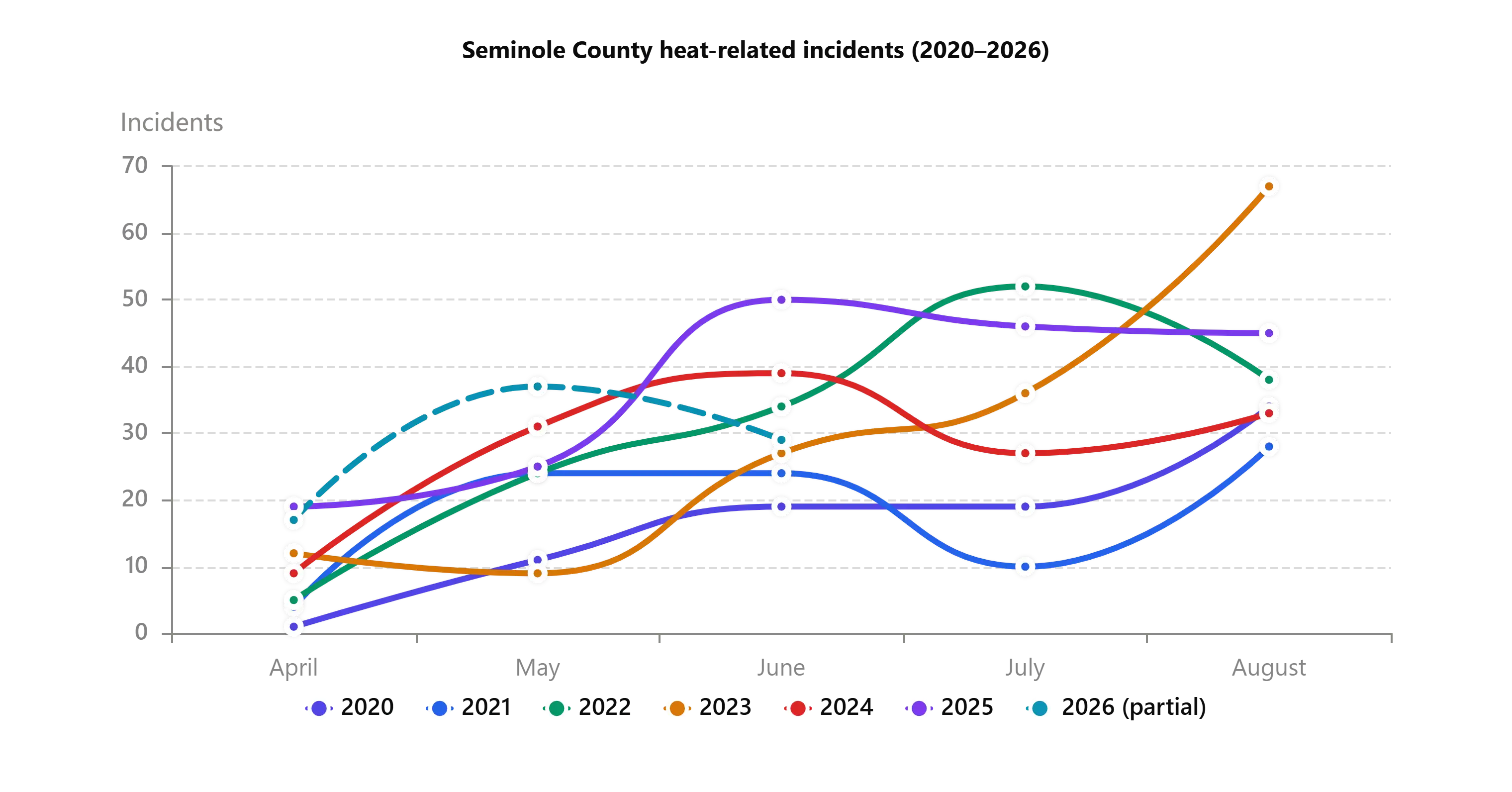
Fire departments across Seminole County responded to 29 heat-related incidents between June 1 and June 22, 2026, according to data from the Seminole County Fire Department. That’s on pace with recent summers, as the county has averaged 50 or more heat-related calls per year in recent years.
A six-year trend
Six years of data from the Seminole County Fire Department tells a consistent story: heat emergencies spike every summer, and the numbers have grown. Call volumes typically climb from spring into the summer months, with July and August historically generating the highest totals.
In 2025, fire crews logged 50 calls countywide in June, followed by 46 in July and 45 in August — the most sustained stretch of high-volume months in the six-year dataset. The single-month record belongs to August 2023, when crews responded to 67 heat-related incidents countywide. July 2022 stands out as another outlier, with 52 calls — the highest July total on record.
What fire crews are seeing
Lt. Dave Williams of the Seminole County Fire Department says heat-related emergencies are largely preventable.
“So typically, throughout the past couple of years, we’ve averaged about 50 or more calls for heat-related emergencies,” Williams said. “And half of those times we transport.”
“The one thing that we’re seeing with the trend is that they’re not taking those simple little steps to make a preventable injury or heat-related illness, not even exist,” Williams said.
Who is most at risk
Williams says certain groups face greater danger in the heat than others.
“Agewise, the highest risk factors that we see are going to be our pediatric patients and the elderly,” he said. “They just don’t have a heat cooling system with their skin and energy system that works as efficiently as we do in the prime of our life.”
He notes that outdoor workers, athletes, and firefighters also face elevated risk — but cautions that no one is immune.
“Anyone that’s outside doing an activity, regardless of your age, really is our key factor,” Williams said. “But those primary groups would be the elderly and pediatrics.”
Recognizing a heat emergency
Knowing when a heat-related illness is becoming life-threatening can make all the difference, Williams says.
“You’re going to start with just the mild signs and symptoms — the being tired, the sweating,” he said. “But when you start transitioning to where there’s confusion, and especially when the sweating stops or the unconsciousness unresponsiveness — that’s where we’re now into a heat stroke versus a heat emergency.”
Tips to stay safe this summer
The most important thing anyone can do, Williams says, is hydrate — and not wait until feeling thirsty to do it.
“If you’re thirsty, you’re already behind the eight ball,” he said. “Hydrate before. If you’re going to be outside in the sun for hours, put some electrolytes in there as well, because you lose electrolytes as well as when you’re sweating.”
Florida’s signature heat-humidity combination makes the risk even greater, he adds.
“In Florida, we have a heat index. So even though it’s 85 degrees outside, the feels-like temperature — that heat index — is something that’s very important,” Williams said. “The higher the humidity, the higher the heat index. That humidity is sticking on your skin. Your body doesn’t have a chance to evaporate and cool itself as it would normally.”
Williams recommends bringing a water bottle and drinking continuously — even when not thirsty — seeking shade and taking regular rest breaks.
If your AC goes out
A failing air conditioner during extreme heat can quickly become a dangerous situation. Williams says don’t wait it out at home.
“Go out and do something fun for the day — go see a movie, go to the mall, go shopping — do something inside where air conditioning is present,” he said. “And check on your neighbors. If you know a neighbor is having issues financially and can’t get it repaired, check on them.”
Don’t forget the pets
Williams says pets are just as vulnerable to extreme heat as people — a reminder especially relevant during summer outings.
“Our pets are just as susceptible to this heat as we are — and they don’t have shoes,” he said. “So, when they walk on that hot asphalt and pavement, be careful. Be cognizant of their pads.”
Worth noting for anyone heading to Red Hot & Boom: pets are not permitted at Cranes Roost Park beginning at 7 a.m. on July 3.
Staying safe at Red Hot & Boom
The 29th annual Red Hot & Boom is set for July 3 at Cranes Roost Park in Altamonte Springs. The free event runs from 5 to 10 p.m., with a fireworks show scheduled to begin at 9:30 p.m., weather permitting. Country singer-songwriter Chris Lane headlines the evening’s entertainment.
With thousands of attendees expected to arrive early to secure their spots, Williams says large outdoor events like this one are exactly when heat safety awareness matters most.
“Everyone gets out there early; they want the best seats,” he said. “And even though it might be cloudy, they don’t realize that it’s going to be really hot out there. The UV rays coming through — get your sunscreen on. Start hydration before you even come out that day. Start the night before.”

Get breaking news alerts delivered to your inbox.